How to Turn a Loksewa Syllabus into a 7-Day Revision Plan
Build a practical seven-day Loksewa revision plan from your official syllabus, with daily priorities, recall practice and a final check.
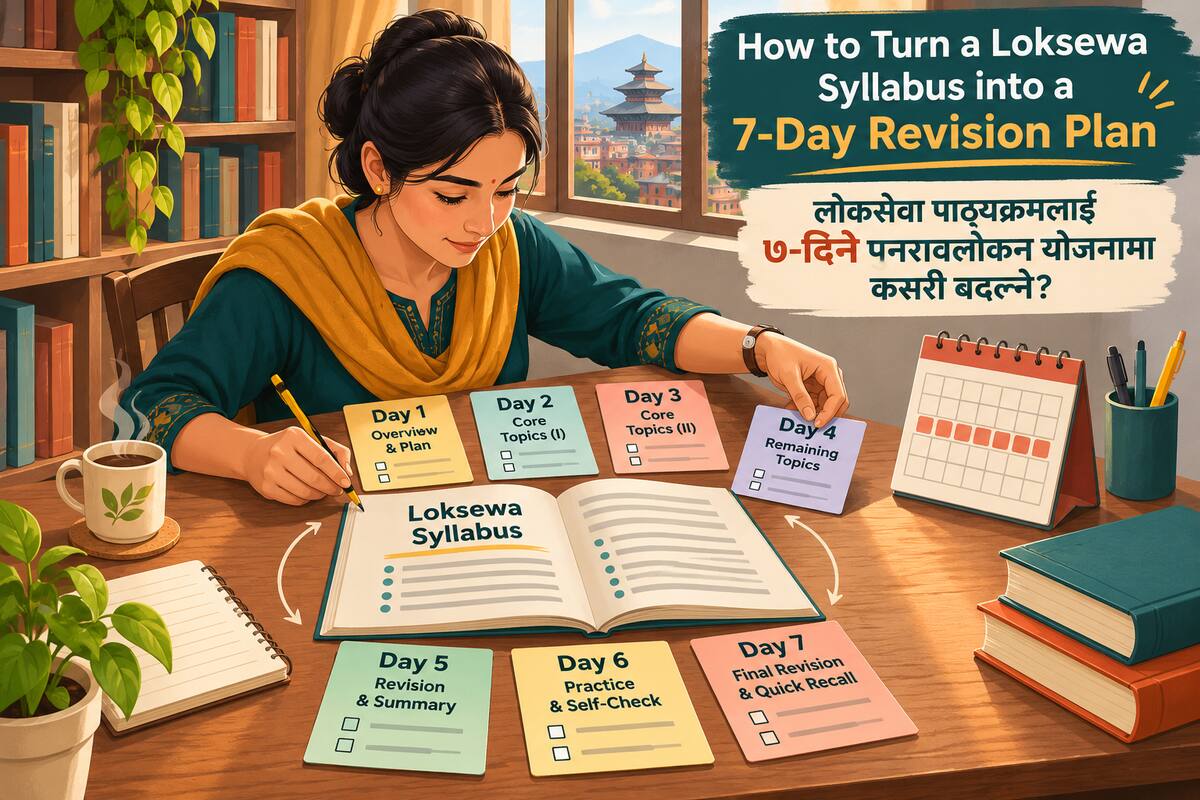
How do you make a Loksewa revision plan from the syllabus?
Start with the syllabus, not with the book you opened most recently. When the exam is close, candidates often revise what feels familiar and leave important sections untouched. A seven-day Loksewa revision plan gives every listed area a place, then leaves room for recall and correction.
Use the official syllabus as your master list
Download or check the paper and post that match your application in the Public Service Commission syllabus archive. Write every main unit on one sheet. Do not copy every sub-point yet; mark each unit A, B or C: A for weak or high-weight topics, B for familiar topics that need revision, and C for topics you can refresh quickly.
Make a realistic seven-day map
Give A topics your best hours. A workable week is not seven identical study days. On Day 1, map the syllabus and revise the first A unit. Days 2 to 4 cover the remaining A units. Day 5 is for B units and short factual lists. Day 6 is for past questions or timed recall. Day 7 is for a final mixed review and your error notebook.
Set one output for each study block
‘Study governance’ is too vague. Use an output you can check: make a one-page topic map, answer five self-made questions, explain a process aloud, or write a short response under a timer. A block without an output easily turns into rereading.
Keep the plan proportional to the paper
If a paper has objective and subjective parts, revise both deliberately. Spend some blocks on facts, terms and comparisons; spend others on organising an answer. For written work, use the five-minute written-answer review after a timed response so a weak structure does not repeat in the next attempt.
Build recall into every day
Close your notes for the last 15 minutes of each session. List what you remember, then compare it with the syllabus or notes. Mark only the gaps. The next morning, begin by recalling yesterday’s topic before opening new material. This short loop is more useful than collecting new highlights.
Protect Day 6 and Day 7
Do not fill the final two days with new chapters. Day 6 should expose your weak points through a mixed quiz, past question set or timed written answer. Day 7 should reduce load: key frameworks, dates you genuinely need, definitions, and the errors you marked during the week. Leave enough time to organise admission materials and rest.
Seven-day revision checklist
- Official syllabus matched to your exact post and paper.
- A, B and C priorities marked.
- One visible output planned for every block.
- Daily recall time protected.
- Final two days reserved for practice and error review.
A short plan works only if it is honest about your available hours. If you miss a block, move its priority—not the entire timetable. Return to the syllabus each day so your revision stays complete rather than merely busy.